



Personal Loan Rejected? 7 Possible Reasons and What to Do Next
Introduction
Applying for a Personal Loan can be a convenient way to manage medical expenses, education costs, home repairs or other financial requirements. However, receiving a rejection from a lender can be frustrating, especially when you need funds urgently.
A Personal Loan rejection does not necessarily mean you will never qualify for credit. Lenders assess several factors, including your income, repayment capacity, existing financial obligations, employment stability and Credit Score, before making a decision.
Understanding why your application was rejected can help you take corrective steps before applying again. It can also help you avoid repeated applications that may affect your credit profile.
At Andromeda Loans, we recognise the importance of understanding your borrowing options before making a financial decision. This guide explains seven common reasons for Personal Loan rejection and practical steps you can take to improve your eligibility.
1. Low Credit Score
Your Credit Score is one of the factors lenders may consider when evaluating a Personal Loan application. It reflects information in your credit history, including repayment behaviour and credit utilisation.
A low score may indicate previous payment delays, high outstanding balances or limited credit history. However, lenders use different eligibility criteria, so there is no single Credit Score that guarantees approval across all lenders.
What can you do?
- Check your credit report for incorrect information.
- Pay existing EMIs and credit card dues on time.
- Reduce outstanding credit card balances where possible.
- Avoid submitting multiple loan applications within a short period.
- Allow time for positive repayment behaviour to be reflected in your credit profile.
Explore our guide to How to Improve Your Credit Score to learn more about building a stronger credit history.
Expert tip: Check your credit report before applying again. Correcting an inaccurate entry may help, but improvements in your credit profile can take time.
2. Insufficient Income or Low Repayment Capacity
Lenders evaluate whether your income is sufficient to support the proposed EMI alongside your existing financial commitments.
Even if you earn a regular salary, a high level of existing debt may reduce the amount you can comfortably repay. Self-employed applicants may also need to demonstrate sufficient income stability through the documents accepted by the lender.
What can you do?
- Review your monthly income and expenses.
- Reduce outstanding debt where financially practical.
- Choose a loan amount that fits your repayment capacity.
- Provide accurate income and employment information.
- Compare eligibility criteria across suitable lenders.
Remember that the maximum loan amount advertised by a lender may not be available to every applicant.
3. High Existing EMI Obligations
If you already have multiple EMIs, credit card repayments or other financial commitments, a lender may conclude that an additional Personal Loan would stretch your finances.
For example, imagine that you earn ₹50,000 per month and already pay ₹25,000 towards existing EMIs. A lender may consider the remaining income insufficient for the additional EMI you have requested, depending on your living expenses and its eligibility criteria.
What can you do?
- Calculate your total monthly debt obligations.
- Avoid borrowing more than you need.
- Consider reducing existing outstanding balances.
- Review your household budget before taking on another EMI.
- Apply for a loan amount that reflects your actual repayment capacity.
The objective should not simply be to secure approval. It should be to choose a loan that you can repay comfortably.
4. Unstable Employment or Irregular Income
Lenders may review your employment history, income consistency and length of service when assessing a Personal Loan application.
Frequent job changes, a recent move to self-employment or irregular business income may make it more difficult for some applicants to meet a lender’s requirements.
However, employment stability requirements vary. Changing jobs does not automatically make you ineligible for a Personal Loan.
What can you do?
- Provide current employment and income documents.
- Ensure that salary credits or business income can be verified where required.
- Maintain accurate financial records.
- Review the lender’s minimum employment or business-vintage criteria.
- Consider applying when your financial documentation clearly reflects your current circumstances.
Self-employed applicants should check whether the lender accepts their business income and the supporting documents available to them.
5. Incorrect or Incomplete Application Details
Errors in your Personal Loan application can delay processing or lead to rejection.
Common issues include discrepancies between your application and income documents, incorrect contact information, incomplete forms or outdated employment details.
Lenders may also reject applications when the information provided cannot be verified.
What can you do?
Before submitting another application:
- Check your name and personal details.
- Verify your employment and income information.
- Ensure that required documents are complete and readable.
- Update incorrect information where necessary.
- Respond promptly to legitimate verification requests.
Always provide accurate information. Never alter salary slips, bank statements or other documents to improve your chances of approval.
6. Applying for a Loan Amount That Exceeds Your Eligibility
A lender may reject your application if the requested amount is higher than what your income, credit profile and existing obligations support.
For instance, an applicant with moderate income and several existing EMIs may not qualify for the same loan amount as someone with a higher income and fewer financial commitments.
What can you do?
- Use an EMI calculator to estimate repayment obligations.
- Review your monthly budget.
- Compare the requested amount with your actual funding requirement.
- Consider a smaller loan if it adequately meets your needs.
- Check the lender’s eligibility criteria before submitting an application.
A smaller, manageable loan may be more appropriate than taking on an obligation that puts pressure on your finances.
7. Errors or Negative Information in Your Credit Report
Sometimes, a Personal Loan application may be affected by information in your credit report that is inaccurate, outdated or unfamiliar to you.
For example, a loan you have already repaid may still appear as outstanding, or an account you do not recognise may be listed in your name.
Such discrepancies should be investigated rather than ignored.
What can you do?
- Obtain your credit report from an authorised credit information company.
- Review account balances, repayment history and personal details.
- Raise a dispute with the relevant credit bureau and lender when you identify an error.
- Keep records of your complaint and supporting documents.
- Check the updated report after the dispute is resolved.
Do not assume that every negative entry is incorrect. Verify the information and follow the appropriate dispute process.
What Should You Do Immediately After a Personal Loan Rejection?
If your Personal Loan application has been rejected, follow these steps before applying again.
Step 1: Understand the reason. Review the lender’s communication and request clarification if necessary.
Step 2: Check your Credit Score and credit report. Look for repayment issues, incorrect entries or excessive outstanding balances.
Step 3: Review your finances. Calculate your income, expenses and existing EMIs to understand how much additional repayment you can afford.
Step 4: Correct the underlying problem. Update inaccurate information, address overdue payments or improve your financial documentation.
Step 5: Compare suitable lenders. Check eligibility criteria, interest rates, fees and repayment terms before submitting another application.
Step 6: Apply when you are better prepared. Avoid repeatedly applying to multiple lenders without addressing the original reason for rejection.
There is no universal waiting period after a rejection. The appropriate time to reapply depends on why the application was rejected and whether the underlying issue has been resolved.
Can You Get a Gold Loan If Your Personal Loan Is Rejected?
A Gold Loan may be an alternative for some borrowers who own eligible gold jewellery and need funds.
Unlike a typical unsecured Personal Loan, a Gold Loan is secured by gold pledged with the lender. The lender generally assesses the jewellery’s purity, eligible weight and value when determining the loan amount.
| Factor | Personal Loan | Gold Loan |
|---|---|---|
| Security | Generally unsecured | Eligible gold is pledged |
| Key assessment factors | Income, credit profile and repayment capacity | Gold valuation, borrower verification and lender criteria |
| Loan amount | Based on eligibility and lender policy | Based on assessed gold value and applicable LTV limits |
| Main consideration | Ability to repay from income | Ability to repay while protecting pledged gold |
A Gold Loan is not automatically available to everyone whose Personal Loan application is rejected. Lenders still apply their eligibility and verification requirements.
Before choosing a Gold Loan, compare the interest rate, processing charges, repayment structure and consequences of default. If you fail to repay, the pledged gold may be auctioned after the lender follows the applicable requirements and procedures.
Explore Gold Loan to understand the factors that may influence your options.
How Can a Personal Loan Agent Help?
A Personal Loan Agent may help prospective borrowers understand available loan products, identify relevant eligibility requirements and navigate the application process.
Depending on the agent’s role and the services offered, assistance may include explaining documentation requirements, comparing available options and helping applicants understand the next steps.
However, an agent cannot guarantee approval or override a lender’s eligibility criteria.
Before working with an agent, verify their authorisation or association with the relevant organisation. Never share your OTP, banking password or other confidential credentials, and be cautious of anyone promising guaranteed approval in exchange for an upfront fee.
At Andromeda Loans, prospective borrowers can explore relevant lending information and learn about available loan options before deciding how to proceed.
Common Mistakes to Avoid After a Loan Rejection
Avoid these mistakes when planning your next application:
- Applying repeatedly without understanding the reason for rejection.
- Ignoring overdue EMIs or credit card payments.
- Providing incorrect information or incomplete documents.
- Borrowing more than your financial situation supports.
- Assuming that a high Credit Score guarantees approval.
- Paying unauthorised individuals who promise guaranteed loans.
- Choosing a loan without comparing the total borrowing cost.
A thoughtful approach can help you avoid unnecessary applications and make better-informed borrowing decisions.
Frequently Asked Questions
Q1. Why was my Personal Loan rejected despite having a good Credit Score?
A good Credit Score does not guarantee approval. Lenders may also consider income, existing EMIs, employment stability, requested loan amount, documentation and internal eligibility criteria.
Q2. Does a Personal Loan rejection affect my Credit Score?
A rejection itself is not generally recorded as a separate negative entry in your credit report. However, the lender’s credit enquiry may be recorded, and multiple applications over a short period can affect how lenders assess your credit profile.
Q3. How long should I wait before applying again?
There is no fixed waiting period that applies to every applicant. Review the reason for rejection and address the underlying issue before reapplying.
Q4. Can I get a Personal Loan with a low Credit Score?
Some lenders may consider applicants with lower scores, but eligibility, interest rates and loan amounts vary. Approval is not guaranteed, and improving your credit profile before applying may be beneficial.
Q5. Is a Gold Loan a good alternative to a Personal Loan?
A Gold Loan may suit borrowers who own eligible gold and are comfortable pledging it as security. Compare the total cost and repayment conditions carefully because failure to repay can put your pledged jewellery at risk.
Conclusion
A rejected Personal Loan application can be disappointing, but it can also be an opportunity to review your finances and identify areas for improvement.
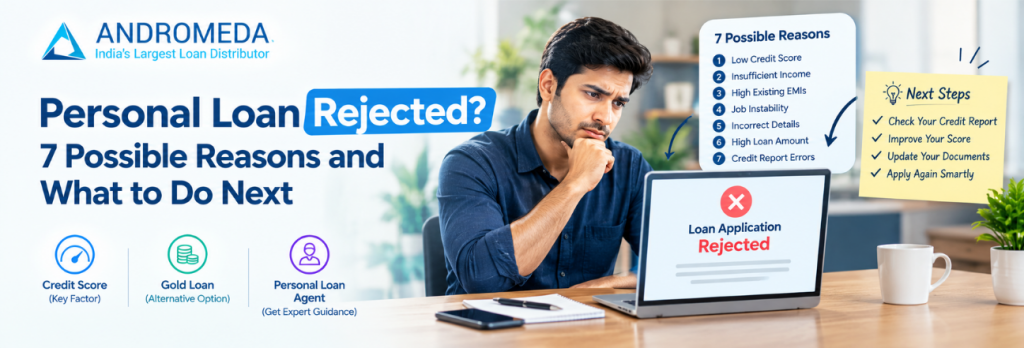
Low Credit Score, insufficient repayment capacity, high existing EMIs, employment instability, incorrect application details, an excessive loan amount and credit-report errors are seven possible reasons for rejection.
Before applying again, understand the lender’s decision, review your credit report, organise your documents and select a loan amount that fits your budget. If a Personal Loan is unsuitable, you may also explore alternatives such as a Gold Loan, provided you understand the associated costs and risks.
Andromeda Loans encourages borrowers to explore their lending options carefully and make informed financial decisions. Whether you are researching Personal Loan eligibility or seeking information from a Personal Loan Agent, prioritise transparent terms, responsible borrowing and a repayment plan that supports your long-term financial well-being.


